
DREAM x CACHE Target 2035 Challenge
Click image to enlarge
A DEL-ML Challenge Targeting PGK2
We are pleased to launch the DREAM x CACHE Target 2035 Drug Discovery Challenge, which is now accepting predictions.
Part of the Target 2035 initiative, this successor to the inaugural DREAM Target 2035 Drug Discovery Challenge is made possible via a collaboration between The Structural Genomics Consortium (SGC), the labs of Damian Young at Baylor College of Medicine and Neelagandan Kamariah at InStem, IBM (DREAM) and Sage Bionetworks, with logistical and technical support from Conscience and BEACON. All data and results will be shared openly and publicly.
The Scientific Challenge
In this DEL-ML challenge, participants are invited to retrospectively and prospectively predict small molecules that bind phosphoglycerate kinase 2 (PGK2), an enzyme essential for sperm motility and a promising target for non-hormonal contraception.
Participants have access to all chemical structures and PGK2 binding data from a DNA-encoded library (DEL) screen of close to a billion compounds, on which they can train their machine learning (ML) models. They should then use their models to retrospectively retrieve hits from an affinity selection mass spectrometry (ASMS) screen of 400K compounds that were confirmed in a kinase assay. Participants who retrieve the most diverse set of hidden hits will then be invited to prospectively predict novel hits from Enamine’s catalog, which will be procured and tested experimentally.
The winners of the challenge will be determined based on the number of novel chemical series identified from the test set and the overall number of hits, as determined in the prospective phase of the challenge.
Participation Cost
Participation in the retrospective phase of the challenge is free.
The top 10 participants from the retrospective phase will be invited to advance to the prospective phase where they will each purchase 50 compounds in-stock at Enamine . The organizers will cover 100% of the costs of testing compounds experimentally.
Participants from low and medium income countries who advance to the prospective phase can have all expenses covered by the SGC if they are part of the MAINFRAME Open Science Machine Learning Network for Drug Discovery. Organizers will also cover the costs of procuring compounds for the top 4 participants from the retrospective phase if they are members of MAINFRAME.
For Canadian participants Conscience will fund up to 50% of the eligible participation costs. Please see the details outlined below.
How to Participate
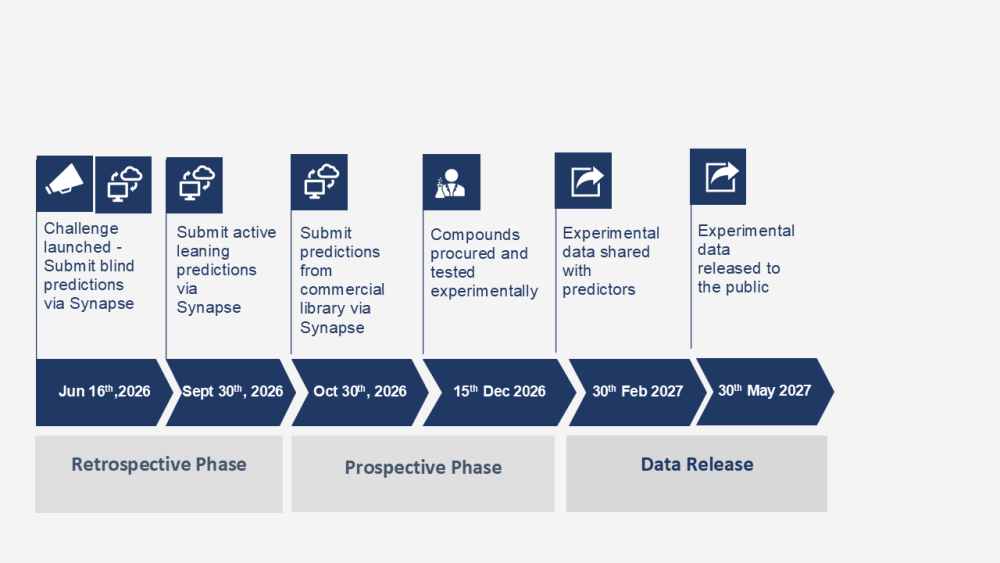
Sign up to participate via the Synapse platform. The first submission deadline for predictions in the retrospective phase of the challenge is September 15th. To learn more about the challenge and ask any questions you might have, please register to attend the challenge launch webinar, which will take place via Zoom on July 7, 9am EDT/ 3PM CEST.
We welcome participants from around the world and are committed to improving equity, diversity and inclusion in computational drug discovery. We strongly encourage applications from individuals and teams from groups that are underrepresented in our research community. .
All applications and submissions to this DREAMXCACHE Challenge are subject to the CACHE Terms of Participation. For any questions or inquiries please email [email protected]

2026-06-16

2026-09-29

Timeline
Details
Canadian Participants
Conscience will fund up to 50% of the eligible participation costs (including direct labour, direct materials/compound procurement, compute, and other direct costs required to perform the work) for eligible Canadian academics and companies (up to $75,000 for SMEs and $50,000 for academics per challenge phase [1. Retrospective, 2.Prospective]). Funding is reimbursement-based, meaning costs must be incurred and paid before reimbursement, and successful applicants must enter into an Ultimate Recipient agreement with Conscience.
The top performing Canadian participants will have the opportunity to have their predictions tested experimentally in a separate prospective stream funded by Conscience, even if they did not place in the top 10 of the main challenge. Such participants will not be included in the final ranking of the main challenge.
Please fill out this form so that Conscience can contact you with more details about the funding structure.